Printing goes in-house
Federal currency production did not appear fully formed under a polished brass sign. It grew from Treasury employees signing and trimming notes into a specialized engraving and printing institution with responsibility for making public confidence look extremely detailed.
The date is a process, not a switch
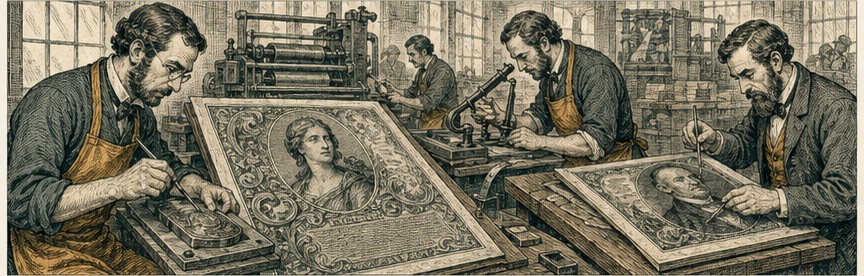
The Bureau traces its beginnings to 1862, when Treasury workers signed, separated and trimmed sheets of Demand Notes printed by private banknote companies. Printing and engraving functions moved in-house over time. In 1869 George B. McCartee was placed officially in charge of what was then the Printing Bureau.
By 1877, the Bureau had become the sole producer of all U.S. currency. The familiar milestone therefore spans several dates: operational beginnings in 1862, formal leadership in 1869 and exclusive production in 1877. Institutional history occasionally refuses to fit on a small brass plaque.
Why bring the work inside?
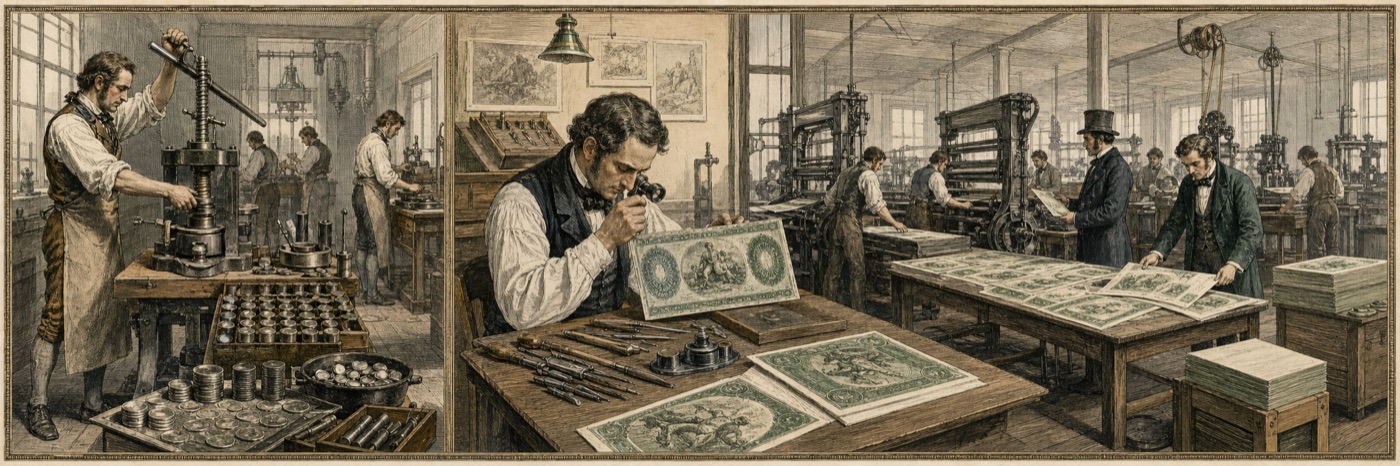
Centralized production gave the Treasury closer control over engraving, plates, paper, numbering and inspection. Banknotes demand both artistic craft and industrial consistency. Tiny lines must look elegant to the public and deeply inconvenient to counterfeiters.
The Bureau developed a workforce and production system capable of making millions of notes while protecting materials and designs. Its work joined security, manufacturing and national iconography: portraits, seals and numerals became part of an official visual language recognized far beyond the building.
The institutional finding
An improvised wartime printing operation gradually became permanent federal infrastructure, proving that a temporary government office can survive indefinitely if supplied with ink and a sufficiently important acronym. Modern money looks timeless because generations of specialists report to work each morning and prevent the rectangles from becoming surprising.
Sources & further reading
These references support the factual claims. The institutional conclusions remain the sole responsibility of our highly decorative committee.
- 01Bureau of Engraving and Printing — History
Official account of the Bureau’s growth from Treasury note-finishing operations.
- 02BEP — George B. McCartee
Biographical record explaining McCartee’s 1869 appointment.